

Once your bathroom is set up for success (see Part 1), it’s time to focus on preparing the most important part of the equation – your child! Part two of our toilet training series dives into how to support your child to understand the toilet and learn about their body. This blog is packed with tips to help you and your little one feel ready for the toilet journey ahead!
Resources to help your child learn about toilets:
- Reading books is an engaging and easy way to learn and spark conversations around toileting. There are so many picture books or lift the flap books available on learning about the body, how wees and poos are made, or why we use toilets.
- See our blog on Bluey and Bingo’s favourite toilet books for examples
- Keep some wipeable toilet-focused books in the toilet area to look at when practicing on the toilet or during changes.
- Watch Toms Toilet Triumph – we love how this video shows the steps of toileting clearly, and also focusses on the body sensations we get that tell us when it’s time to wee or poo.
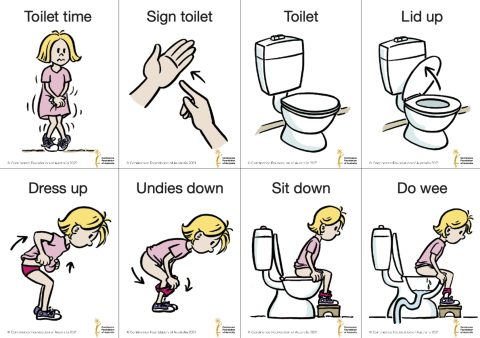
- Create or use a visual of the steps for toileting. Having a clear sequence of routine can help your child anticipate and, when ready, participate in a task such as getting the toilet paper or flushing.
- These pictures from the Continence Foundation of Australia are clear and easy to understand.
![]()
Source: Continence Health Australia
- These pictures from the Continence Foundation of Australia are clear and easy to understand.
- Watching videos and playing some toilet app games can also be a fun way to learn about using the toilet e.g. Pepi Bath 2
- Playing games that have a selfcare or toilet theme can be helpful in learning the steps to toileting, and reducing any fear or worry of the toilet. There are so many fun new poo toys like Pet Scan, Doo Doo Kangaroo and Poop Shoot.
Help your child develop their understanding of key concepts that underlie toileting
- Develop concepts of wet, dry, dirty, clean, front, back, big, small, full, and empty as these can all relate to the toilet task and be learned at other times of the day. Our blog on teaching body sensations has lots of ways to learn this through play!
- “Stop – Pause – Go” games are a great way to help your child stop an activity, switch to another task, and then take an action. Pause is an important skill to help with stopping and waiting, and helps us be able to act on our body feelings when they send us a message!
- Encourage counting; this skill helps with many aspects of toileting. Including learning to count how many squares of toilet paper we need, how long to sit on the toilet for, how long to wash our hands, how many pumps of liquid soap… the list goes on!
How to talk and learn about wees, poos and toilets together:
- Talk about when you need to use the toilet, by modelling the body feelings that you experience. For example, saying “my bladder feels full of wee, I need to pause and go to the toilet!”
- Talk about these body sensations for wee and poo so your little one can begin to notice these in their own body. Consider – Where do I feel poos or wees coming? How does my body tell me I need to wee/poo?
- Play with dolls or other favourite characters and take them to the toilet. Bluey and Bingo are a big hit with our clients in clinic sessions, as we explore together using the toilet and what happens if there is a wee/poo accident.
- Use the same words or phrases for wees and poos, as building consistency helps with understanding. Where possible, also use the correct anatomical name for body parts to enable the child to communicate clearly – especially in the event that they need to be specific about a pain or problem.
- Encourage your child to be more involved in the task of cleaning up during a nappy change, and to get a clean nappy or pull-up.
- Establish routines that support communication in different environments such as in day care/education settings. E.g. “After morning tea, first toilet time, then play time.” Your child then has an opportunity to prepare, anticipate and increase their independence to action healthy tasks for long term daily functioning.
With the right preparation, you and your child can feel more confident in moving forward with their toileting. Remember – every child’s journey is different, and progress takes time. Stay patient, celebrate the little wins, and don’t hesitate to revisit our related blogs for more tips and support. You’ve got this, and so does your little one!
ROS PULLMAN
Occupational Therapist.
References:
Toilet Training Book – A Developmental Look at Toilet Training for Kids of All Needs. Collen Beck OTR/L, Cindy Chuan OT, Lauren Drobnjak PT, Heather Greutman COTA/L, Claire Heffron OTR/L, Jaime Spencer OTR/L – 2019
https://www.continence.org.au/get-support/who-can-help/national-continence-helpline


