

It’s a question here at Kids That Go we are asked frequently. If you search online there will be so many results, and it can be very confusing and conflicting.
At Kids That Go our Occupational Therapists adopt an individualised approach. The truth is that each child we see is different, even siblings (including twins) are not always alike, so our focus is on what the child’s current skills are. Together we work collaboratively with parents and carers to problem solve and develop strategies to support your child and family.
What is key to understand, is that achieving independence to use the toilet is a very complex task. It involves lots of critical components or steps that are linked to one another.
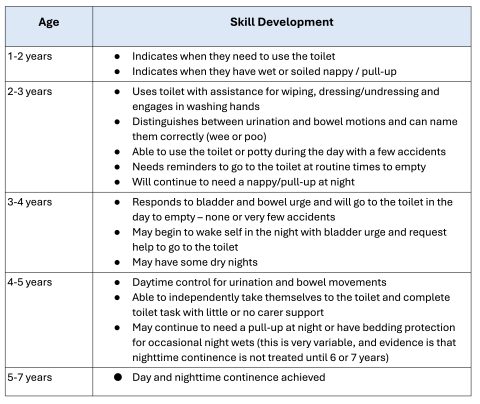
Knowing where your child is performing can be helpful in identifying their level of skill development. Below is a basic checklist you can use as a guide to understanding the developmental stages that can provide insight into when children are potty or toilet ‘ready’ and whether your child would benefit from further support.
Developmental Toileting Milestones
Abridged version for purpose of this Blog using reference from HELP strands (Published by VORT Corporation (1992/2013)
To be able to assess whether your child is ready to commence potty and toilet training, the first step is to be a keen observer. Take notice when your child is showing an interest and an indication of bladder and bowel awareness and is motivated to participate in toileting. Below are some key areas to observe.
Is your child:
- noticing bladder or bowel urge awareness? This can be very variable especially if your child does not yet have words to verbalise the feeling. They may have a ‘tell’ or physical gesture / body sign to identify that they can feel a poo or a wee. Children may ‘freeze’, ‘stare into the distance’, look down or touch their nappy/pull-up indicating they can feel wees and poos coming.
- showing some voluntary control to hold-on for short periods (1 to 2 hours) between sensing urge and voiding?
- able to remain dry for nap times indicating they may be physically ready to hold their poos and wees?
- regular poos and no soiling during sleep times?
- saying “I feel a wee coming”, “toilet” or use a hand sign to gesture toilet?
- noticing they are wet or dry – they may act differently and pull at their nappy/pull-up or shorts?
- curious with checking out different toilets and observing carers using the toilet – e.g. following parent to the toilet?
- retreating to a quiet corner / space to open bowels into nappy/pull-up – showing you that they are aware that opening bowels is a private activity?
- wanting to sit on the potty and copy others (e.g. like an older sibling)?
- keen to wear undies?
- interested in helping with getting toilet paper, flushing, and washing hands?
- engaging in role play with dolls/favourite characters that involves taking them to the toilet?
- talking about what poos and wees feel like, smell and colour, shape, size?
- feeling happy to go to the toilet for practice and clean-ups?
So, if your child is exhibiting some of these abilities then initiating toilet training could be a timely step forward on their toileting journey. They are showing you that they are receptive and ready, so it is our job to listen and use this opportunity to build their skills. However, it is important to be mindful that you need to have the support, time and resources in place to undertake this process.
If you feel you or your child is needing extra support for toileting, an occupational therapist for toileting can be a great help. Look out for one of our next blogs in the coming months: “Setting Up for Toilet Success”.
ROS PULLMAN
Occupational Therapist
References:
Toileting Skills Masterclass – 2023 – Rebecca Khan, Kids That Go Therapies
Learning to Conquer the Wees & Poos – Beyond the Basics – 2021 – Rebecca Khan, Kids That Go Therapies
The Toilet Training Book – A Developmental Look at Toilet Training for Kids of All Needs. Collen Beck OTR/L, Cindy Chuan OT, Lauren Drobnjak PT, Heather Greutman COTA/L, Claire Heffron OTR/L, Jaime Spencer OTR/L – 2019


